
Hydrocyclone Side Stream Filtration System (HSSF)™
We understand the challenges of suspended solids, dust, organic matter, and corrosion products circulating within cooling water systems. These impurities cause scaling, fouling, biological growth, and corrosion, which significantly impact cooling tower efficiency and reliability. Cooling towers are the heart of HVAC and process cooling systems. However, dust, silt, algae, organic matter, and other suspended solids accumulate in circulating water. This leads to fouling, scaling, corrosion, and high maintenance cost. A Side Stream Filtration System continuously filters a portion (5–15%) of circulating water, keeping your cooling system clean, efficient, and reliable.
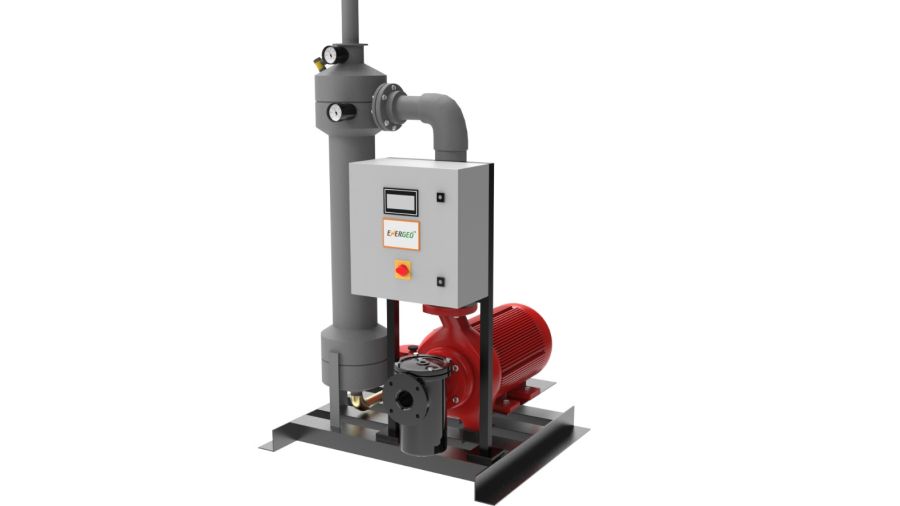
A hydrocyclone side stream filtration system is an efficient mechanical solution used in cooling towers to continuously remove suspended solids from circulating water. Operating on centrifugal force, the hydrocyclone separates heavier particles such as sand, silt, scale, and debris from the water without the use of filter media.
A controlled side stream—typically 5–10% of the total recirculation flow—is diverted through the hydrocyclone, where solids are forced to the outer wall and discharged through a purge, while clean water returns to the system. By reducing total suspended solids, the system helps prevent scale formation, fouling, and erosion of heat exchange surfaces. This leads to improved heat transfer efficiency, reduced chemical consumption, and lower maintenance costs.
Hydrocyclone side stream filtration systems are compact, low-pressure-drop devices with minimal moving parts, making them reliable and easy to maintain. They are especially effective in cooling towers exposed to dusty or high-contaminant environments, supporting longer equipment life and more stable cooling tower performance.
HYDROCYCLONE SIDE STREAM FILTRATION SYSTEM (HSSF)™ Benefits on Cooling Towers:
- High filtration efficiency as removal of suspended solids, silt, and debris for cleaner water.
- Reduce downtime and hassle-free operation for all cooling tower capacities.
- Improve water quality for recirculation and enhances water reuse, reduces fresh water intake, and cuts operating costs.
- Simple design with low moving parts and minimal space requirement.
Advantages of Hydrocyclone Side Stream Filtration System(HSSF™)
Operational Efficiency
- Removes heavy particles like sand, silt, and sediment
- Prevents fouling and scaling in heat exchangers and pumps
- Reduces manual cleaning frequency
Design & Maintenance Benefits
- No moving parts – easy to install and maintain
- Compact footprint
- Adjustable grit port size
Water & Cost Savings
- Improves water recirculation
- Reduces fresh water consumption
- Lowers operational costs
Performance Highlights
- High efficiency for fine particle separation
- Large processing capacity
- Quick purge cycles
Working Principle od HYDROCYCLONE SIDE STREAM FILTRATION SYSTEM (HSSF)™
The Hydrocyclone Side Stream Filtration System (HSSF)™ enhances cooling tower performance by efficiently removing suspended solids using centrifugal force.
How it works:
- Side-stream filtration: - A dedicated pump diverts 5–10% of the total cooling water flow into the system.
- Tangential entry: - Water enters the unit tangentially, generating a high-speed vortex.
- Centrifugal separation: - Heavier particles (sand, silt) move outward toward the cyclone wall and settle downward.
- Clarified return: - Clean water rises through the central vortex and returns to the cooling system.
- Continuous operation: - With no moving parts, the system ensures reliable and low-maintenance performance.
This process protects critical components—heat exchangers, pumps, and nozzles—from fouling, scaling, and abrasion.